


HOU at the OpenEU Alliance Workshop on Digital Education Quality at the EADTU I-HE2026 International Conference
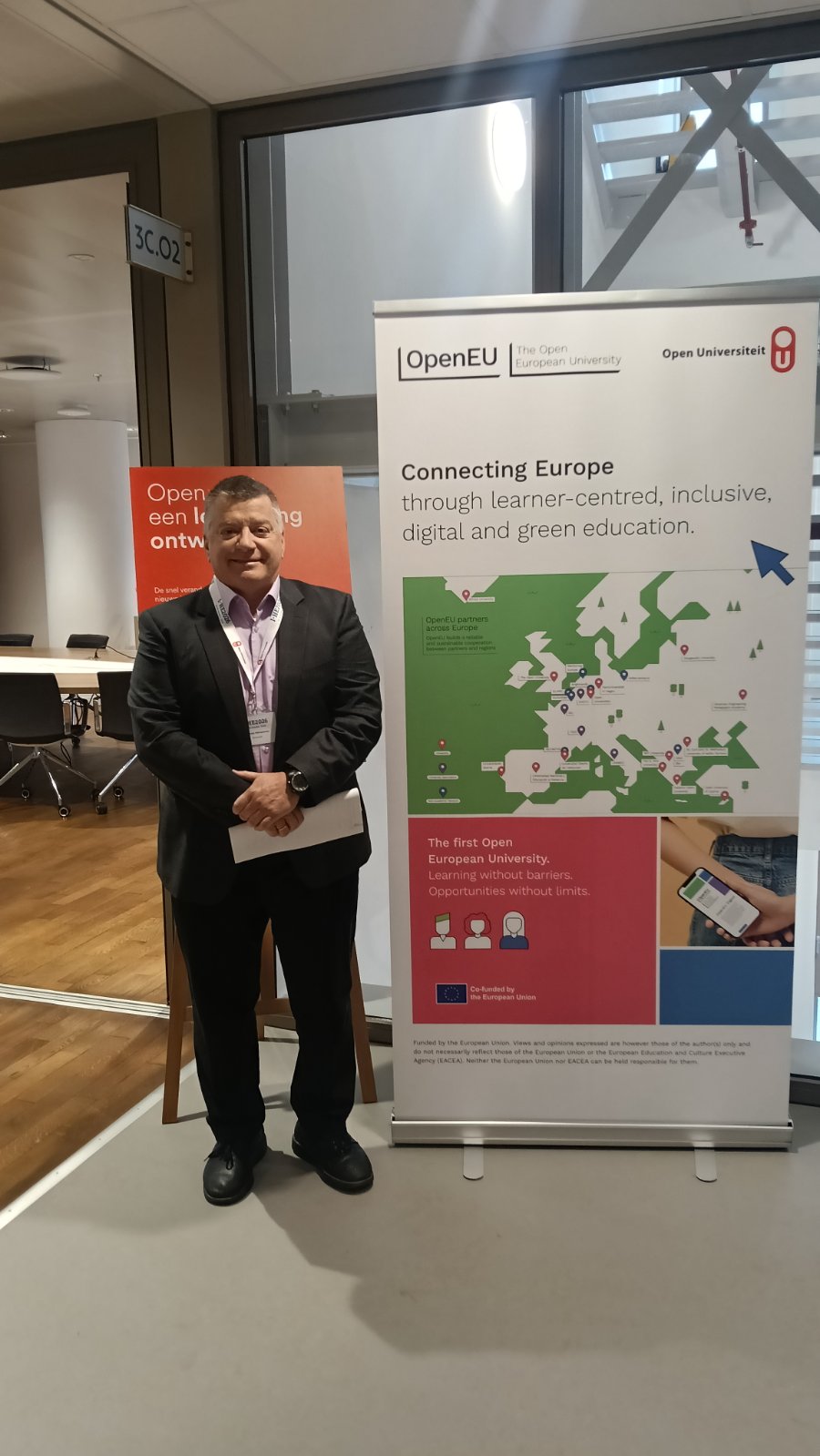
On 30 October 2026, the OpenEU Alliance’s interactive workshop, “Think and Do Tank (TaDT): Stress-Testing Digital Education Futures through Value-Sensitive Co-Creation,” took place in The Hague. The workshop was held within the framework of the I-HE2026 International Conference, “From Innovation to Impact: Transforming Higher Education at Scale,” organized by the European Association of Distance Teaching Universities (EADTU) from 28–30 October and hosted by the Open Universiteit of the Netherlands. The Hellenic Open University (HOU) was represented at the workshop by Professor Sarandis Mitropoulos, serving as a member of the OpenEU Think and Do Tank team.
The workshop was designed and coordinated by Haline Maia (Universidade Aberta, Portugal) and was integrated into the conference track on international cooperation through Alliances, networks, and joint degrees. It constitutes the second phase of the OpenEU Think and Do Tank (WP5), focusing on quality assessment criteria for digital education and its institutions.
From Priorities to Value Tensions
The first cycle of the Think and Do Tank combined a broad expert consultation with a Delphi study, resulting in the six thematic areas of the OpenEU Innovation Agenda on Digital Education:
- Pedagogical innovation
- Smart digital infrastructures
- Empowering educators and students
- Ethics
- Institutional governance
- Data assurance
Experts agreed on a human-centric direction, identifying the empowerment of educators and students as the top priority. Artificial Intelligence was accepted conditionally: as a supportive, optional tool subject to human oversight.
However, this consensus conceals inherent tensions that emerge when these priorities are put into practice:
- Efficiency versus equity
- Personalization versus privacy
- Automation versus human agency
- Speed of innovation versus accountability
- Interoperability versus institutional autonomy
These findings are presented in the accompanying conference paper, “From Consensus to Value Tensions: Expert Priorities for the Digital Transformation of Higher Education in a European University Alliance,” co-authored on behalf of HOU by Sarandis Mitropoulos and Dimitris Kalles.
Workshop Methodology
Participants worked using the Value Sensitive Design (VSD) methodology, which places human values at the core of the design, evaluation, and governance of digital educational systems.
The workshop analyzed a wide range of value pairs stemming from the six thematic areas—including personalization and privacy, automation and human agency, and transparency and security. Each pair was examined by a team of two participants, tasked with answering four key questions:
- What value does each side protect?
- Who gains and who loses when one prevails over the other?
- Which quality criterion can strike a balance between them?
- With what success indicator and what early warning sign can this balance be monitored in practice?
The objective was not merely to reach consensus on the importance of quality, but to examine who defines it, how it is measured, and with what consequences.
HOU’s Participation
Sarandis Mitropoulos examined the tension between openness and privacy. The central question was how cross-border, collaborative learning environments within European University Alliances can remain open to knowledge exchange while simultaneously safeguarding students’ personal data in compliance with the GDPR. This issue is particularly pertinent for an open university collaborating across Europe through OpenEU.
Assistant Professor Evangelia Manousou also participated in the workshop as a delegate.
Next Steps
The workshop outcomes are being jointly processed by the Alliance partners and will be utilized to further enrich the OpenEU Innovation Agenda on Digital Education. They will also inform the broader European dialogue on quality assurance and international cooperation in higher education. Subsequently, the Agenda’s priorities are expected to be pilot-tested through the Alliance’s Living Labs (WP4).
Through its active participation in the OpenEU Alliance, HOU contributes meaningfully to shaping a human-centric model for the digital transformation of higher education—one that embeds values at every stage, from initial design to final evaluation.
